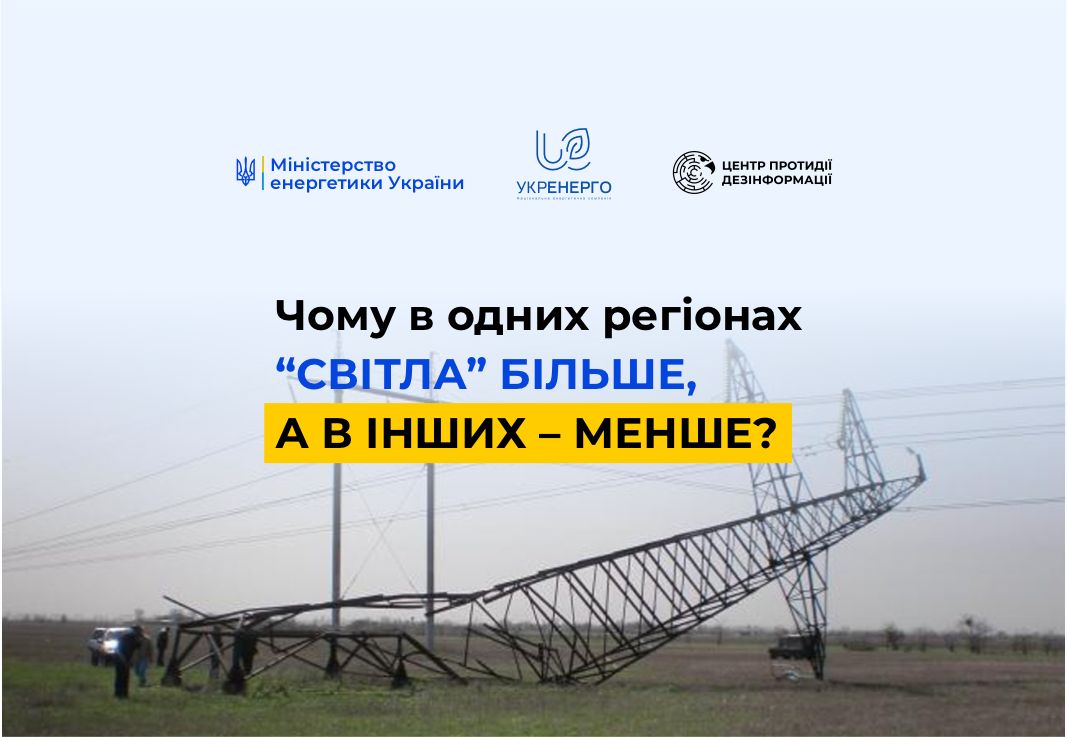
Why is there less electricity in Kyiv than in Lviv? Why, overall, are outage schedules more “lenient” in western regions? This question is among the most frequently asked on social media. The answer lies not in unfairness, but in physics.
The main problem is the destruction or damage of generation facilities in frontline and border regions with Russia. In addition, the enemy deliberately targets transmission systems—high-voltage lines, the so-called “energy bridges” that connect regions. Many people perceive the power system as a single shared “pool” from which electricity can be evenly distributed to everyone. Unfortunately, the reality is more complex.
Today, the main electricity generation capacities are largely concentrated in western Ukraine, where nuclear power plants are located and where electricity imports from Europe enter the system. This region can potentially produce more electricity than it consumes. The east, south, and central parts of the country—where generation has been severely damaged by shelling—are energy-deficient.
To transmit electricity from the west to Kyiv or Kharkiv, high-voltage lines and autotransformers are required. The enemy deliberately targets precisely these facilities.
As a result, due to damage to these “arteries,” electricity remains effectively “locked” in the regions where it is generated or imported. This is why restrictions may be fewer in the west, while shortages are felt more acutely in central, southern, and eastern regions. The transmission capacity of networks that were not designed for such volumes is simply insufficient to transport electricity on this scale.
The situation is further complicated not only by massive attacks, but also by localized shelling in frontline areas and accidents caused by system overloads. Something breaks down every day—and every day power engineers work to repair it.
Therefore, differences in the duration of outages are not a matter of preference or policy, but the result of objective physical constraints.