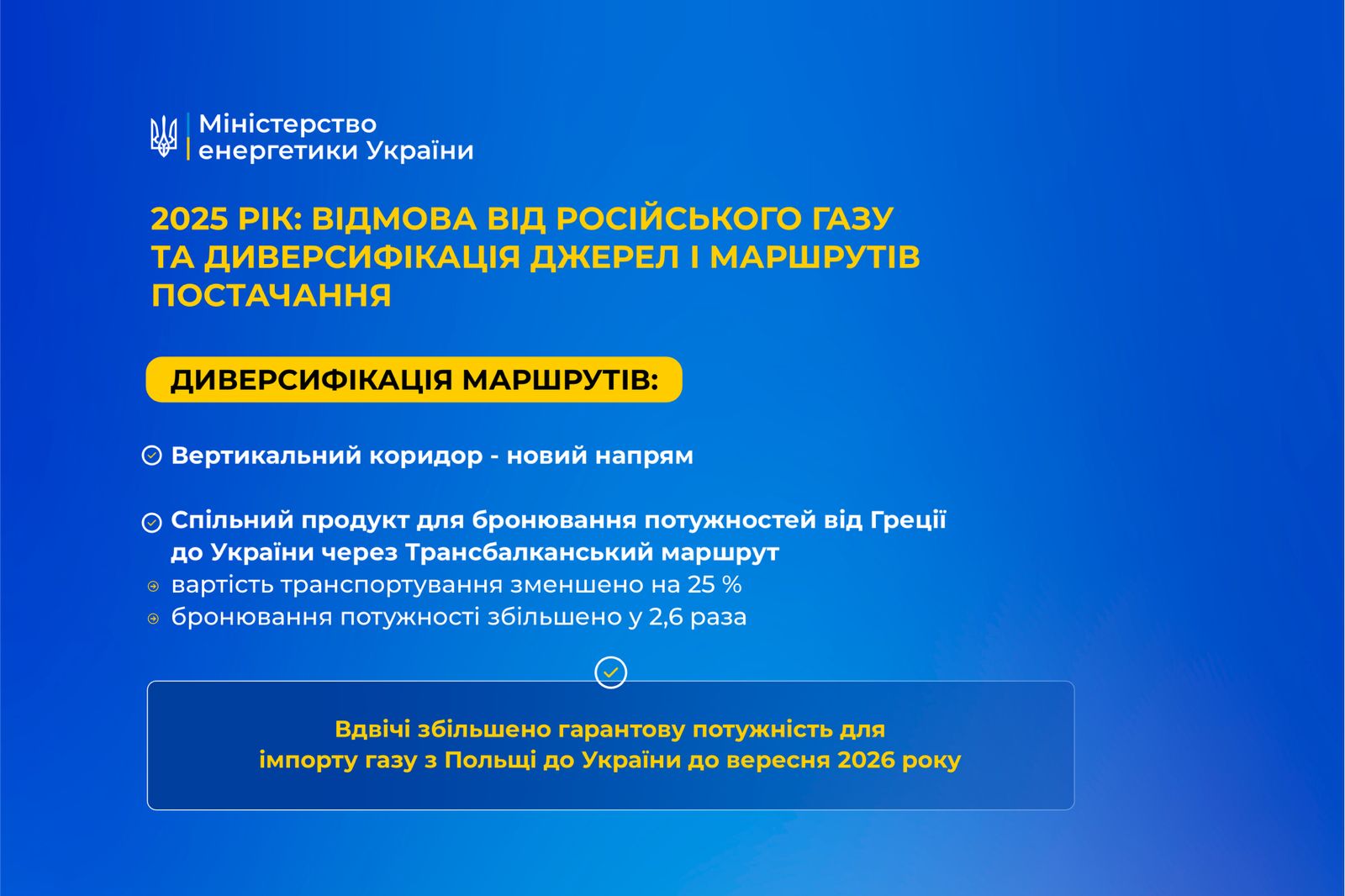
In 2025, Ukraine fully halted the transit of Russian gas through its gas transmission system (GTS). As of 1 January, Ukraine’s GTS has been operating without the transit of Russian gas.
At the same time, since the beginning of the year, approximately 6.9 billion cubic metres of gas have been transported through interconnection entry points. These volumes include both gas imports to meet Ukraine’s domestic needs and gas transportation via Ukraine’s GTS to supply other countries.
The year 2025 marked a period of strengthened partnerships and joint efforts aimed at diversifying gas supply routes and sources.
In particular, in 2025 Ukraine, together with neighbouring countries, launched a new southern gas import route — the Vertical Corridor. This route is of particular importance in the context of supply security and serves as an alternative to the eastern route.
In addition, a joint capacity booking product from Greece to Ukraine was introduced. Gas transmission system operators of Ukraine, Bulgaria, Greece, Moldova, and Romania developed an optimised solution for importing gas to Ukraine via the Trans-Balkan route at a competitive tariff. As a result, transportation costs along this corridor were reduced by 25%, while booked capacity on the Trans-Balkan route increased 2.6 times.
The gas transmission system operators of Poland and Ukraine doubled the guaranteed transmission capacity until September 2026. The Polish gas import route is being gradually strengthened and plays an important role in ensuring natural gas imports to Ukraine. It also provides access to new supply sources, including LNG terminals in Poland and Lithuania, significantly expanding supply options and enhancing Ukraine’s energy security.
In 2025, Ukraine contracted natural gas supplies from Azerbaijan, with the first test deliveries commencing as early as July via the Trans-Balkan gas pipeline. This marked a strategically important step in diversifying gas supplies.
Moreover, Ukraine opened a new chapter in transatlantic cooperation by developing a route for the supply of U.S. LNG via Greece. During the P-TEC event, the Naftogaz Group and the Greek company ATLANTIC-SEE LNG TRADE S.A. signed a memorandum on future regular supplies of U.S. LNG to Ukraine through Greek gas terminals and the Vertical Corridor. The long-term partnership covers a horizon up to 2050. It will enable the phased implementation of new strategic projects, including ensuring stable long-term LNG supplies for Ukraine, integrating Ukraine’s infrastructure into LNG logistics routes to Europe, and establishing a sustainable system for the supply and storage of U.S. LNG.
In 2025, international partners provided Ukraine with substantial financial support for the procurement of natural gas. In particular, the European Bank for Reconstruction and Development extended a EUR 500 million revolving credit facility backed by an EU guarantee; the Government of Norway allocated nearly USD 100 million; and the European Investment Bank provided EUR 300 million to build strategic gas reserves ahead of the heating season.